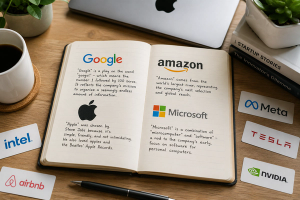
The Meaning Behind Famous Tech Company Names (Why “Google”? Why “Apple?”)
Some of the world’s biggest tech companies have names so familiar that most people rarely stop to think about where they actually came from. Yet behind many of these names are surprisingly interesting stories involving math terms, personal inspiration, misspellings, and creative branding decisions.
From garage startups to trillion-dollar corporations, these companies carefully chose names designed to be memorable, unique, and easy to recognize worldwide. In many cases, the names also reflect the company’s original mission or philosophy.
Here’s the meaning behind some of the most famous tech company names.
Key Takeaways
- Many tech company names were inspired by science, math, or creativity.
- Simple and memorable names helped brands stand out globally.
- Some famous names actually began as spelling mistakes.
- Company names often reflect original business goals or philosophies.
- Strong branding played a major role in building tech giants.
Why Is It Called Google?
Google’s name comes from the mathematical term “googol,” which refers to the number 1 followed by 100 zeros. The name was chosen to represent the company’s mission of organizing massive amounts of information on the internet.
Interestingly, the company’s founders, Larry Page and Sergey Brin, reportedly ended up with the spelling “Google” by accident after a brainstorming session and domain search. The misspelled version stuck — and eventually became one of the most recognized brand names in history.
The name perfectly reflected the company’s ambition to handle enormous amounts of online data.
Why Is It Called Apple?
Apple’s name is surprisingly simple compared to many tech companies. Steve Jobs reportedly chose the name because he liked apples and wanted something friendly, approachable, and non-technical.
At the time, many technology companies had cold or complex-sounding names. “Apple” stood out because it felt human, simple, and easy to remember. Jobs also liked that the name appeared ahead of Atari in phone books.
The brand’s simplicity became a huge part of its identity and marketing success.
Why Is It Called Microsoft?
The name “Microsoft” combines two words: “microcomputer” and “software.” Co-founder Bill Gates originally used the name to describe the company’s focus on creating software for early personal computers.
The name first appeared as “Micro-Soft” before the hyphen was eventually removed. At the time, the name clearly communicated exactly what the company did, which helped establish credibility during the early computer revolution.
Today, the name has become so iconic that most people never think about its original meaning.
Why Is It Called Amazon?
Jeff Bezos chose the name “Amazon” because he wanted something that represented scale, power, and global reach. The Amazon River, being the largest river in the world, symbolized the company’s ambition to become the biggest bookstore — and eventually the biggest online marketplace — in the world.
Bezos also liked that the name started with the letter “A,” which helped the company appear near the top of alphabetical lists in the early days of the internet.
The name reflected enormous ambition long before Amazon became a global giant.
Why Is It Called Netflix?
Netflix combines the words “internet” and “flicks,” with “flicks” being a slang term for movies. The name reflected the company’s original mission of delivering entertainment through internet-based technology.
When Netflix launched in the late 1990s, streaming barely existed. Initially, the company focused on DVD rentals by mail before eventually pioneering the streaming industry.
The name turned out to be surprisingly future-proof as online entertainment completely transformed media consumption.
Why Is It Called Samsung?
The name Samsung comes from the Korean words “sam” meaning “three” and “sung” meaning “stars.” Together, the name symbolizes strength, greatness, and longevity.
When the company was founded in 1938, it wasn’t even a technology business — it originally operated as a trading company. Over time, Samsung expanded into electronics, becoming one of the world’s largest tech manufacturers.
The name reflects the company’s broader vision of power and permanence rather than technology specifically.
Conclusion
The names behind major tech companies often reveal fascinating stories about ambition, branding, creativity, and vision. Whether inspired by mathematics, nature, or simple word combinations, these names helped shape some of the most recognizable brands in the world.
What makes these stories especially interesting is how ordinary many of the names initially seemed. Few people could have predicted that words like “Google,” “Apple,” or “Amazon” would one day become global symbols of modern technology.
Today, these names are far more than company labels, they are part of everyday culture and digital life itself.