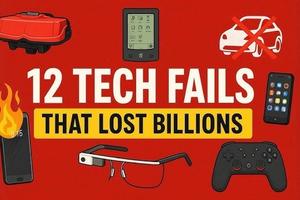
The 5 Most Expensive Tech Failures in History
The tech industry is built on innovation, but not every ambitious idea succeeds. Some products that were expected to revolutionize the world ended up becoming legendary failures instead. Despite massive investments, aggressive marketing, and huge public expectations, certain technologies collapsed so badly that they cost companies billions of dollars.
What makes these failures fascinating is that many came from some of the biggest and smartest companies in the world. Even industry giants can misjudge timing, consumer behavior, or technological limitations.
Here are five of the most expensive tech failures in history.
Key Takeaways
- Even major tech companies can make catastrophic mistakes.
- Poor timing and unrealistic expectations often contribute to failure.
- Expensive marketing cannot save products people don’t want.
- Some failed products later inspired successful technologies.
- Tech history is filled with ambitious ideas that arrived too early or executed poorly.
1. Google Glass
When Google introduced Google Glass in 2013, the company presented it as the future of wearable technology. The smart glasses allowed users to access information, record videos, send messages, and use voice commands directly through a tiny display positioned in front of the eye.
The hype was enormous, but the public reaction quickly turned negative.
People raised concerns about privacy because the glasses could record video discreetly in public spaces. The design also looked awkward to many users, and the high price made adoption difficult.
Google reportedly spent hundreds of millions developing and marketing the product before eventually discontinuing the consumer version. While smart glasses may still return in the future, Google Glass became one of the most famous tech flops ever.
2. Microsoft Zune
Microsoft launched the Zune in 2006 hoping to compete directly with Apple’s iPod. The company invested heavily in hardware, software, and marketing, expecting the device to become a major player in portable music.
The problem was simple: Apple already dominated the market.
Although the Zune wasn’t necessarily a terrible product, it failed to offer enough compelling advantages over the iPod ecosystem. Consumers had already embraced iTunes and Apple’s sleek branding, making it difficult for Microsoft to catch up.
The project reportedly cost Microsoft billions overall and eventually disappeared from the market entirely.
3. Meta’s Metaverse Push
Few recent tech projects generated as much hype, or skepticism, as Meta’s massive investment into the metaverse.
After rebranding from Facebook to Meta in 2021, the company poured tens of billions of dollars into virtual reality, digital worlds, and metaverse development. CEO Mark Zuckerberg described the metaverse as the future of the internet.
However, adoption remained far lower than expected. Many users found the technology expensive, unfinished, or unnecessary for everyday life. Critics also questioned whether consumers actually wanted to spend significant time inside virtual worlds.
While Meta continues investing heavily in VR and AR technology, the company’s metaverse ambitions became one of the most expensive and controversial tech bets in modern history.
4. Apple Newton
Long before smartphones and tablets existed, Apple attempted to create a futuristic handheld digital assistant called the Newton in the 1990s.
The device included features that were far ahead of its time, including note-taking, touch input, and handwriting recognition. Unfortunately, the technology simply wasn’t ready yet.
The Newton became infamous for its inaccurate handwriting recognition, which often produced hilarious mistakes. Combined with high costs and limited performance, the product struggled commercially.
Although the Newton failed, many people now view it as an early precursor to devices like the iPhone and iPad.
5. Segway
When the Segway launched in 2001, some people believed it would completely change transportation forever. Investors and media outlets predicted cities would be redesigned around the futuristic self-balancing scooter.
Instead, the product became more of a niche curiosity than a transportation revolution.
The Segway was expensive, impractical for many urban environments, and difficult to integrate into daily commuting habits. Despite years of hype, it never achieved mainstream success.
The product eventually became more associated with guided tourist groups and mall security than the future of transportation.
Conclusion
Tech failures are often just as important as tech successes because they reveal how unpredictable innovation can be. Even companies with enormous resources, talented engineers, and massive marketing budgets can misjudge what consumers actually want.
Interestingly, some failed technologies still influenced future innovation. Products like the Apple Newton and Google Glass introduced ideas that later evolved into successful modern technologies.
In the fast-moving world of tech, failure is often part of the process, but when billions of dollars are involved, those failures become legendary.