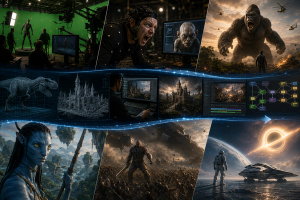
How CGI Has Changed Filmmaking
Computer-generated imagery, better known as CGI, has completely transformed the film industry. What once relied heavily on physical sets, practical effects, and expensive stunts can now be created digitally with remarkable realism. From fantasy worlds and massive action sequences to lifelike animated characters, CGI has expanded the creative possibilities of modern filmmaking in ways that were once unimaginable.
Over the past few decades, CGI has evolved from a groundbreaking innovation into a standard part of movie production. Today, it plays a major role in everything from superhero blockbusters to independent films, helping directors bring their visions to life with greater flexibility and precision.
Key Takeaways
- CGI allows filmmakers to create scenes and effects that would be impossible or too expensive in real life.
- Modern CGI has significantly improved visual realism in movies.
- Filmmakers use CGI for both large-scale blockbusters and subtle visual enhancements.
- The technology has changed how actors, directors, and visual artists collaborate.
- While CGI offers incredible possibilities, many filmmakers still value practical effects for authenticity.
The Early Days of CGI
Before CGI became mainstream, filmmakers relied heavily on practical effects such as miniatures, animatronics, makeup, and physical sets. While these techniques produced iconic movie moments, they often came with limitations.
One of the earliest breakthroughs in CGI came with films like Tron (1982) and The Last Starfighter (1984), which experimented with computer-generated visuals. However, it wasn’t until Jurassic Park (1993) that audiences truly saw the potential of CGI in creating lifelike creatures and immersive worlds.
The realistic dinosaurs in Jurassic Park changed audience expectations forever and proved that digital effects could blend seamlessly with live-action filmmaking.
Creating Entire Worlds
One of the biggest ways CGI has changed filmmaking is by allowing directors to create entire environments digitally. Fantasy and science fiction films especially benefit from this technology.
Movies like Avatar, The Lord of the Rings, and Marvel productions use CGI to build massive fictional universes that would be impossible to construct physically. Entire cities, planets, and battle scenes can now be generated digitally while still looking believable on screen.
This has given filmmakers unprecedented creative freedom, allowing stories to become larger, more visually ambitious, and more immersive.
Enhancing Action and Visual Effects
CGI has revolutionized action filmmaking by making dangerous or impossible scenes safer and easier to produce. Explosions, large-scale destruction, high-speed chases, and complex fight sequences can now be enhanced digitally.
Actors no longer need to perform every risky stunt physically, and filmmakers can create visually spectacular moments without putting crews in unnecessary danger.
Modern CGI is also frequently used for invisible effects that audiences may not even notice, such as removing safety equipment, enhancing weather conditions, or digitally extending backgrounds and crowds.
The Rise of Digital Characters
Another major impact of CGI is the creation of realistic digital characters. Characters like Gollum in The Lord of the Rings, Thanos in Avengers: Infinity War, and Caesar in Planet of the Apes showcase how advanced motion-capture technology has become.
These performances combine human acting with CGI animation, allowing actors to portray characters that would otherwise be impossible to create convincingly.
Animated films have also evolved dramatically thanks to CGI, with studios like Pixar pushing the boundaries of storytelling and visual realism in animation.
The Debate Between CGI and Practical Effects
Despite its advantages, CGI remains a topic of debate among filmmakers and audiences. Some critics argue that excessive CGI can make movies feel artificial or overly reliant on spectacle.
As a result, many directors choose to combine CGI with practical effects to maintain realism and authenticity. Films like Mad Max: Fury Road and Top Gun: Maverick received praise for balancing practical filmmaking techniques with digital enhancements.
This hybrid approach often creates more immersive experiences while still benefiting from the flexibility of modern technology.
Conclusion
CGI has permanently changed filmmaking, opening the door to stories and visuals that once seemed impossible to achieve. From realistic creatures and digital environments to breathtaking action sequences, CGI continues to shape how movies are made and experienced.
At the same time, the best films often use CGI as a tool rather than a replacement for creativity and storytelling. As technology continues advancing, filmmakers will likely keep blending digital innovation with traditional techniques to create even more immersive cinematic experiences.
The future of filmmaking will undoubtedly be shaped by CGI, but great storytelling will always remain at the heart of cinema.